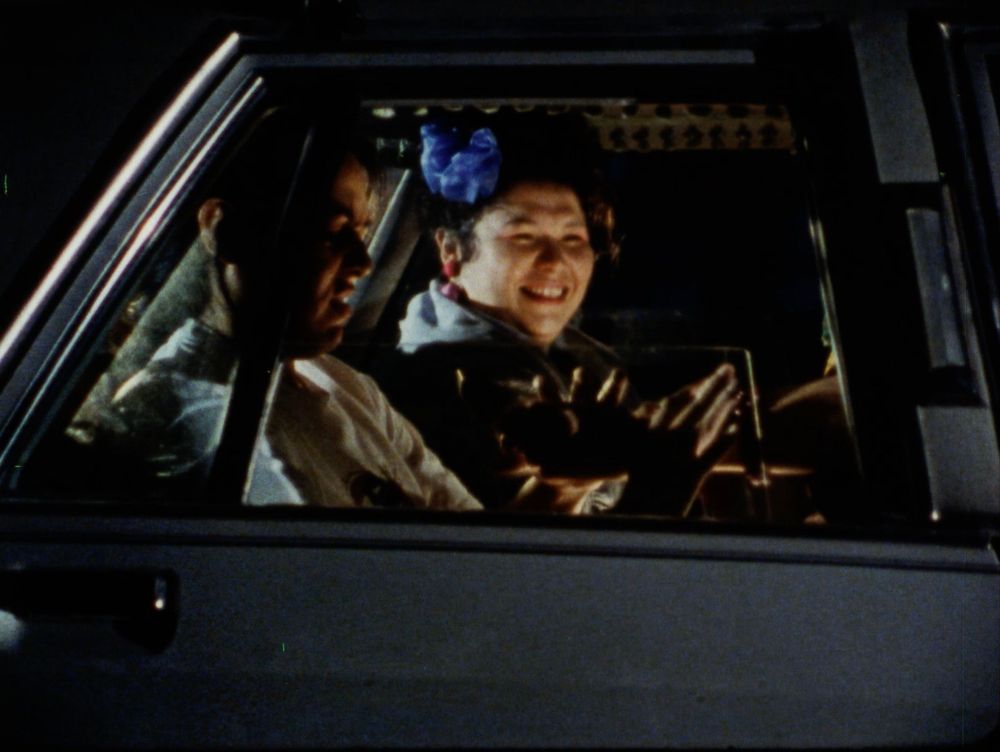
It Starts With a Whisper
Shelley Niro, Anna GronauIt Starts With a Whisper was produced in the Six Nations/Brantford area, with an all-Native cast, and features locations on the Grand River which runs through the Six Nations Reserve. The film blends traditional Iroquois imagery, music and themes with motifs from contemporary, secular life. An original score and innovative visuals make It Starts With a Whisper a delight to watch, as well as a timely challenge to movie stereotypes of First Nations people. Eighteen-year-old Shanna Sabbath, who has grown up on the Reserve, must now decide what path to follow in life. Her aunts’ warmth and humour, and a dream-like encounter with a well-known native leader, help Shanna realize she is loved and is entitled to live her life, remembering and respecting the people of the past and traditional ways.
نظربازی Nazarbazi
Maryam TafakoryAfter the revolution in 1979, Iran prohibited the depiction of men and women touching on the silver screen. Since then, directors have relied on every cinematic trick in the book to mirror the ecstatic release of tension through touch – but often it is the game of glances that is enough to set a scene ablaze. Nazarbazi collages these saturated cinematic moments into a poem about love and desire in Iranian film.
One Hundred Times, Why?
Azadeh ElmizadehOne hundred silk sheets are arranged in a grid of ten by ten, hung on a blank wall. Each individual silk sheet is painted with gouache and ink, with colours ranging from golden orange, to sky blue, to raw white. The forms on each sheet are similar; a fiery triangle with a horse running through, a rider, Siyavash, on the horse’s back. Each repetition bears its own unique details, indicating that each is individually painted directly onto the silk. Encountering these repeated paintings arranged in a grid evokes a sense of sequence and animation.
thinking about forever
Refusal is an unwillingness to accept. In an ableist imperialist white supremacist capitalist cis-hetero patriarchy [1], refusal is also a mode of being that requires consistent rehearsal in order for one to sustain themselves against the violence of these interlocking hegemonic systems. How might we conceptualize Rehearsing Refusal? As a practice of consecutive gestures of defiance [2]? Or, as a stepping into the power of otherwise? Might it hold the potential to speak into being healing, provocation, generation, and liberation? Maybe rehearsing refusal, though trying or inconvenient for those on the receiving end, is an act of generosity for future generations. Perhaps it is the process of building a discipline of hope [3].
This hopeful, generative, and ongoing refusal plays a role in the work of Shelley Niro and Anna Gronau, Maryam Tafakory and Azadeh Elmizadeh presented in thinking about forever. Each artwork gathered in this exhibition also distorts linear timelines by converging what came before with the present moment, and makes way for possible, enmeshed futures.
thinking about forever is presented by Images Festival in partnership with Critical Distance Centre for Curators. We would like to extend a special thank you to Charles Street Video and TPW for their support in loaning technical and exhibition materials.
1. bell hooks, The Will to Change: Men, Masculinity, and Love (New York: Washington Square Press, 2005). See also: bell hooks, “bell hooks and Laverne Cox in a Public Dialogue at The New School,” The New School. October 13, 2014, video,1:36:08. https://youtu.be/9oMmZIJijgY?si=w_JIckIelvsXwnn5.
2. bell hooks, Talking Back: Thinking Feminist, Thinking Black (Toronto: Between the Lines, 1989).
3. Mariame Kaba, We Do This Til We Free Us: Abolitionist Organizing and Transforming Justice (Chicago, USA: Haymarket Books, 2021). In an interview with Kim Wilson and Brian Sonenstien, Mariame mentions hearing the phrase “discipline of hope” in conversation with a nun, who is unnamed in the book.
June 15, 2024, 6-9 pm
June 15, 2024
Wednesday - Saturday, 12-5 pm
Suite 122
401 Richmond Street West
Toronto, Ontario M5V 3A8
Canada
No street level entrance, ramp and elevator available, automatic doors, door width 32”+. Gendered multi-stall and single stall family washrooms, not accessible (-32” wide), automatic doors. No accessible parking on site.
For a map to Critical Distance Centre for Curators, click here
(ARTISTS)